
Are "Internal Amazon Contacts" That Unban Your Store Real? What Sellers Should Know
Key takeaways
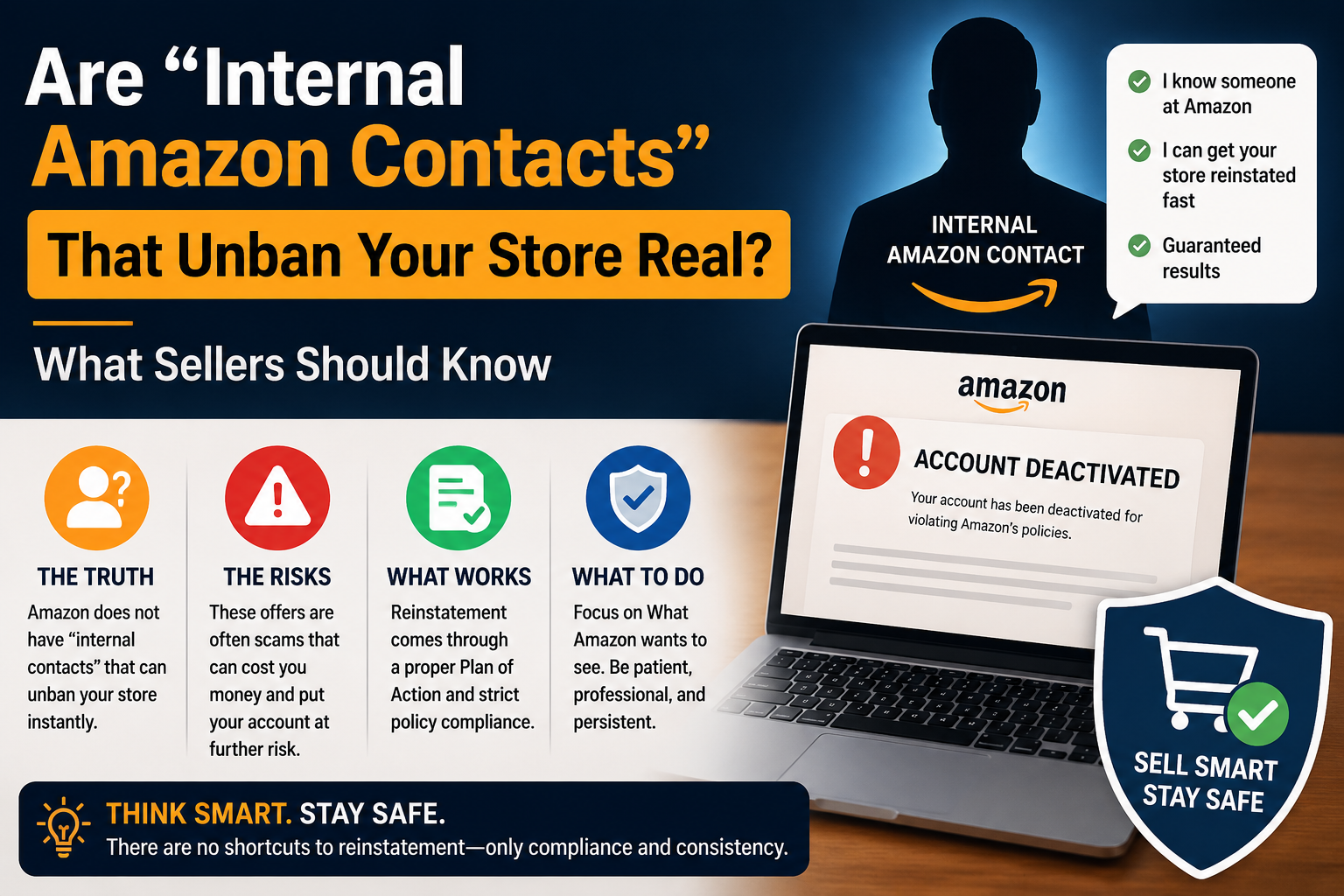
Amazon reinstatement runs through a documented appeal process, not paid “internal contacts.” A “force-open” can lead to a second, permanent ban — and a re-review of funds already released. Most “internal unban” offers are one of three things: a repackaged normal appeal, an appeal built on falsified materials, or legal-sounding marketing. The correct first step is confirming the exact suspension reason, then submitting a targeted appeal (Plan of Action) that addresses it. No service can honestly promise “100% unban.” Account recovery has no shortcuts.
If your Amazon store is banned and your funds are frozen, you’ve probably seen ads promising “L8 internal manager access,” “green-channel approval,” “store restored in hours,” or “instant fund release.” When your money is locked up, these are hard to ignore. But in the account cases our firm handles, “internal force-open” services rarely fix the problem and often leave the account worse off. Here’s what’s actually happening — and what the legitimate process looks like. Do “internal Amazon” unban services actually work?
Short answer: there’s no reliable basis for the claim, and they frequently make things worse.
These services aren’t cheap — pricing is usually based on the frozen amount and store size, from a few thousand to tens of thousands, and higher when more money is frozen. What often follows is that an account gets selling privileges back briefly, then receives a fresh penalty, sometimes a permanent ban. After a second ban, the platform may re-review funds it had already released, closing off any remaining path to recovery. The seller loses a large fee and watches the account lose whatever value it had left.
Are Amazon “internal contacts” real?
Providers claim internal-manager contacts, official review-team relationships, “green-channel” rights, or the ability to restore an account with no appeal. This does not match how the platform works. Amazon’s account review, risk-control, performance, and technical functions operate under strict permission separation, and every change to an account’s status leaves a complete system record. Paying an insider to change your status doesn’t fit that process. And if Amazon determines an account tried to bypass review through improper means, the resulting penalty is usually more severe than the original violation — a pattern consistent with Amazon’s stated policies against manipulating its systems.
What are “internal unban” services really doing?
Across the industry, most “internal unlock” offerings are one of three models:
A normal appeal, repackaged. The provider uses your invoices, shipping records, and brand authorizations to assemble an appeal and submits it through the official public appeal channel — exactly what you could do yourself. Success is credited to “internal relationships”; failure ends the service. There’s no real difference from a standard appeal. An appeal built on falsified materials. When documentation is incomplete, some providers alter invoices, purchase records, or test reports. It may pass review briefly, but if the platform later finds the materials aren’t genuine, it can treat this as submitting false information — triggering a new penalty that’s often harder to recover from than the original. Legal terms used as marketing. Some advertise using concepts like “TRO release,” “court arbitration,” or “asset preservation,” and may ask sellers to sign complex agreements or transfer equity. Understand the actual legal basis and risks before signing anything — don’t sign documents whose legal consequences you don’t fully understand just to release funds faster.
What should you actually do when your Amazon store is banned?
The most important first step is to confirm the exact reason the platform gave, because different violations require completely different responses:
product authenticity issues intellectual property complaints linked-account flags account security anomalies platform policy violations a court-ordered TRO freeze
Each calls for a different strategy. In practice, the accounts that recover are the ones where the seller correctly identified the cause and built a targeted appeal around it; chasing a “guaranteed unban” without identifying the cause often wastes the real window to respond.
What genuinely improves your odds of recovery?
Account recovery has no shortcuts. What actually helps is unglamorous: accurately identify why the account was frozen; prepare truthful, complete evidence to the platform’s requirements; build a targeted appeal or Plan of Action for your specific case type; and get professional legal or compliance help when warranted — especially when a US court TRO or an IP lawsuit is involved, where “fast unfreeze” marketing is most dangerous. The most reliable protection was never an inside contact; it’s compliant operation and risk management put in place before anything goes wrong.
General information only, not legal advice. Every case turns on its own facts.